






I fell in love with a fern
Galloway’s last fragments of temperate rainforest
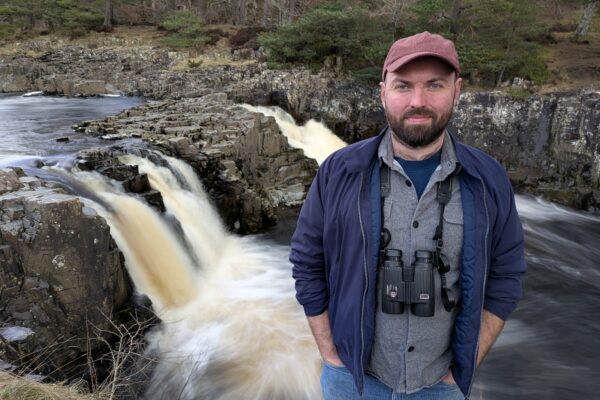
Galloway’s last fragments of temperate rainforest are extraordinary – home to wonderful native species and hosts to migratory birds from Africa. Below author and naturalist Stephen Rutt tells us a little about Refugia, Colin Tennant and Saskia Coulson’s art documentary which is being screened for the first time as part of the festival.
I fell in love with a fern.
It was the only nice day this January – a sparkling day, the light tinged golden all afternoon – when I walked up one of those miniature ravines you get in Galloway valleys. The burn below churned, throwing spray up onto the sheer rock sides of the ravine. Along a narrow lip of walkable ground, I edged forward, admiring the damp green wall of liverworts and mosses – primitive green life – growing on the damp rock. And then a plant I had only read about stopped me mid-step. It looked like a child’s drawing of a hand, flat, uneven fingers grasping out from the wall, reaching out into the damp air. A Wilson’s filmy fern: each of those finger-shaped fronds one-cell thick and translucent green; the entire plant the size of my thumb. A baffling miracle: a terrestrial plant so primitive and delicate it requires the perpetual damp of the spray from the burn and to hide from sunlight in deep shadow of the ravine. A fern so small it can be overlooked as a moss.
I went in search of Colin and Saskia to point out the tiny thing in darkness that needed to be filmed.
Artful migrations visual arts residency
Refugia is the result of Coulson and Tennant’s year spent filming small things in the darkest depths of the Galloway rainforest. Refugia was commissioned as part of Upland’s artful migrations, a visual arts residency with a focus on migratory birds. For this iteration it had a focus on the redstart, the wood warbler and the pied flycatcher: three species that are unrelated but share similarities. They are declining summer residents of the Galloway rainforest. All three eat insects (while the insects eat us), all migrate to the edge of the tropical rainforest in Africa and all of them are beautiful; boldly plumaged birds that are capable of disappearing in the depths of an oak, a vanishing in plain sight that should be possible.
Places where life is sodden and green and contrary
Celtic rainforest – or temperate rainforest – are the ancient woodlands found along the Atlantic edge of Britain. They are places where life is sodden and green and contrary: wet in summer and warm in winter. Defined by climate and the life they hold, they require at least 1.4 metres of rain to fall upon them a year – 10% of that in summer – and for the average temperature of the hottest month to stay below 16 degrees Celsius and the coldest month to remain above 2 degrees. They are places where life can be primitive, like ferns and liverworts, plants that evolved early and make do without flowers. But they are also home to the complex lives of lichens, the opaque breeding behaviour of pied flycatchers and the piggybacking of epiphytes – plants growing on plants.
Galloway’s temperate rainforest are the remains of what would have covered the region. What remains, remains on steep hillsides or tucked away up valleys. Either too difficult to deforest or kept and managed as a source of wood for crannog or canoe; castle timbers or a smuggler’s cover; mill bobbin or charcoal. Nowadays they are often in the care of conservationists. Galloway’s two finest examples (in my opinion), are the RSPB’s Wood of Cree and the Scottish Wildlife Trust’s Carstramon wood; two places where spring blooms in a blue haze of bluebells, scattered with red campion and white wild garlic flowers. Places where spring is a raucous chorus of difficult to see birds. Other pockets can be found. Where Galloway would once have been wild with rainforest, now it is wild with plantations. Dumfries and Galloway’s land is more wooded than the national average. But the percentage of our land that is native woodland is below the national average.
A documentary with a difference
In Refugia Coulson & Tennant have made a documentary with a difference. It situates the migratory birds of the residence within the context of the rainforest where they continue to survive, intertwined with a series of interviews with the people who own the woods, work the woods and enjoy the woods. But it is also unashamedly beautiful, a tribute to spring and summer in the green of Galloway. The light through Coulson & Tennant’s lenses turns leaves and ferns into poetry. Their dronework gives a sense of scale that a map can’t quite convey. Ben Please’s original score weaves its way through the birdsong that I recorded over a series of too-early mornings in May.
It was an absolute gift to be the scriptwriter on this project – the most beautiful project I have ever been involved with – trying to get the story of the wood and its birds to dance with the footage and music. It was also tremendous fun to be its ecological fixer: finding the smallest life in the darkest corners and telling someone else to film it or tracking down the redstarts of the wood, surprisingly elusive for a bird that is bright red, with a song that disappears into the background hubbub of the wood in May.
We are premiering the film at Newton Stewart cinema on 27 and 30 September. Tickets are free.
Buy Stephen's books from our Number Twenty-Six bookshop.


