






Celtic Rainforest Film Reveals Universal Nature of Migration
Filmmakers, naturalist and composer take audiences deep inside the last fragments of an ancient Scottish landscape
Each year pied flycatchers, common redstarts and wood warblers make the risky flight across oceans and continents to summer in Scotland’s temperate rainforests. But farming, commercial forestry and now climate change have reduced these once vast Atlanic oak woodlands to a few remaining fragments.
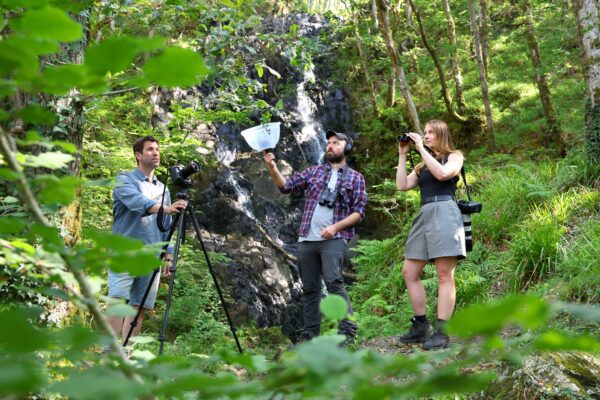
Award-winning documentary filmmakers Saskia Coulson and Colin Tennant (Coulson & Tennant) have teamed up with naturalist and writer Stephen Rutt and composer and musician Ben Please, to make Refugia: A Celtic Rainforest, which explores the astounding richness of Galloway’s remaining areas of Celtic rainforest.
A year of filming flora and fauna
The film will have its first screenings at Wigtown Book Festival, which runs from 25 September to 4 October. Coulson & Tennant, who like the rest of the team live in Dumfries and Galloway, spent a year filming the flora and fauna in the darkest depths of the woodlands. They also incorporate the voices of local people (including conservationists and landowners) into the film alongside the sounds of nature.
Colin said: “We wanted to capture the wonder of the remaining areas of Galloway rainforest and birds and plants that find refuge within them.
“That includes everything from lichens, delicate ferns and oak trees, to the multitude of birds that either live there year round or migrate from Africa.
“Colourful visitors like the redstart, the wood warbler and the pied flycatcher come to Scotland from the rainforests of Africa each year, but as the Galloway rainforest declines so do their numbers.”
Considering migration as a universal and deeply natural act
But the film is one with wider implications. Colin added: “This is a film that considers migration as a universal and deeply natural act. It aims to draw parallels between ecological migration and human movement, reflecting on ideas of survival, belonging, refuge, and home. The few hundred remaining hectares of Galloway rainforest tend to be on steep hillsides or tucked away up valleys - either too difficult to deforest or kept and managed as a source of wood. Nowadays they are often in the care of conservationists, meaning there is some hope for their survival.
The most beautiful project
Stephen said: “It was an absolute gift to be the scriptwriter on this project – the most beautiful project I have ever been involved with – trying to get the story of the wood and its birds to dance with the footage and music.
“These are truly glorious places where spring blooms in a blue haze of bluebells, scattered with red campion and white wild garlic flowers and is a raucous chorus of difficult-to-see birds.
“It is sobering and saddening to think that where so much of Galloway is now covered in commercial conifers it was once wild with rainforest.”
Refugia was commissioned by the region’s arts development organisation Upland CIC and Moving Souls Dance as part of their long-running Artful Migration visual arts programme. Previous Artful Migration projects have focused on individual bird species where Refugia is taking a broader look at an entire habitat.
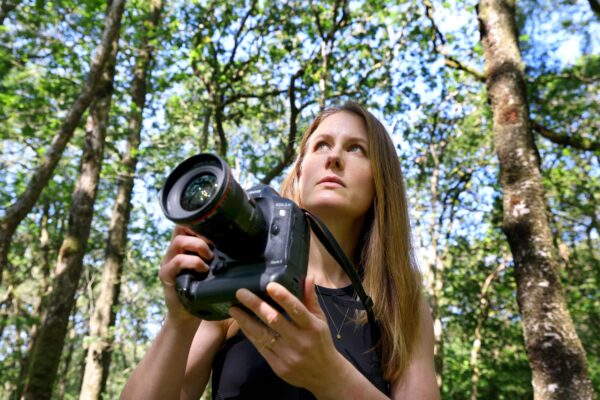
Saskia Coulson
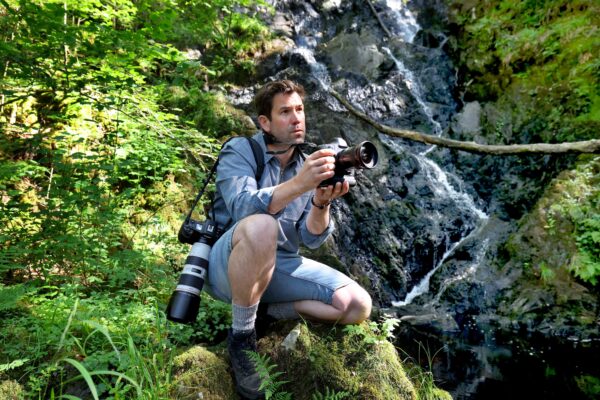
Colin Tennant
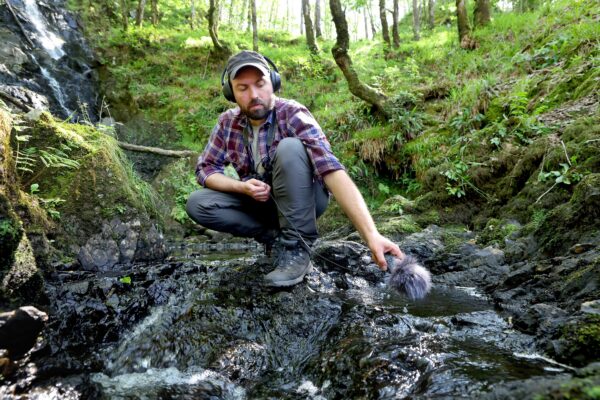
Stephen Rutt
Vulnerability and fragility
Kat Hill, Creative Director of Upland, said: “Upland is delighted to be supporting this important project from such accomplished creatives.
“At a time when so many people worry about the state of the world, Refugia reminds us of the importance of care to and connection for birds, landscapes and people in the face of vulnerability and fragility.”
What is Celtic rainforest?
Stephen describes Celtic rainforest – or temperate rainforest – as the ancient woodlands found along the Atlantic edge of Britain. They are places where life is sodden and green and contrary: wet in summer and warm in winter. Defined by climate and the life they hold, they require at least 1.4 metres of rain to fall upon them a year – 10% of that in summer – and for the average temperature of the hottest month to stay below 16 degrees Celsius and the coldest month to remain above two degrees.
They are places where life can be primitive, like ferns and liverworts, plants that evolved early and make do without flowers. But they are also home to the complex lives of lichens, the opaque breeding behaviour of pied flycatchers and the piggybacking of epiphytes – plants growing on plants.
Organisations such as the RSPB and The Galloway and Southern Ayrshire UNESCO Biosphere are working to conserve what remains. The Refugia team Refugia: A Celtic Rainforest is the creation of a highly accomplished team, all based in the region:
- Saskia Coulson and Colin Tennant (Coulson & Tennant), are an award-winning photography and filmmaking partnership whose work explores relationships between people, place and the natural world (https://wearectproductions.com/).
- Stephen Rutt, naturalist and award-winning author of five books including The Saltmarsh Library, which was commissioned by Wigtown Book Festival (https://stephenrutt.com/).
- Ben Please, BAFTA and Oscar nominated film composer, musician and one half of Wigtown’s internationally celebrated The Bookshop Band (https://www.porterandplease.com/).
The film premiere is part of the Wigtown Book Festival 2026 programme.