






Cal Flyn, Scottish author and journalist, has travelled to some of the wildest, most remote and dramatic places on Earth
Named as 2022 Sunday Times Young Writer of the Year, she has a rare gift for describing the wonders of the natural world
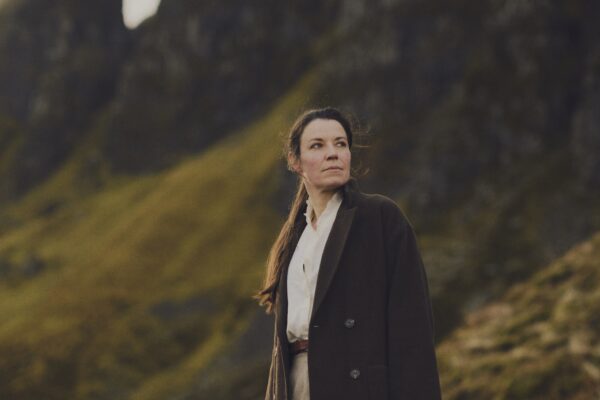
Image credit: Nicholas J.R. White
Cal has real hope that it can be saved from destruction by human activity. In advance of her event at this year's festival, we asked her to tell us about some of her experiences.
In the writing of this book was there a sight or moment that astounded you?
While on a ship off the coast of Antarctica, we were surrounded by enormous icebergs – they are incredibly varied, made of blue ice, white ice, and what they call 'black' ice (perfectly transparent, like
glass) and often stained green or pinky- red by bacteria. There are also huge tabular icebergs, of the kind that have broken in large chunks from an ice sheet and floated out to sea. Some were bigger than islands I have known. While I was out on the deck, I watched as an enormous hunk of ice — a peninsula, really — broke from one of these huge tabular icebergs and collapsed into the sea. It was incredible to watch, and seemed to happen in silence, as the sound took time to carry. Then the sound hit us, and it felt deafening, but no one else had seen the collapse, so everyone else on deck was totally mystified. It felt like a great-earth shattering secret between me and the iceberg, something huge and totally private between ourselves.
With constantly growing demands for food and resources can any wilderness be saved?
Absolutely. Agriculture has become increasingly intensified, and – as populations worldwide – have become more urbanised, a lot of lower-yield farmland has fallen into disuse. This, alongside large political forces (like the collapse of the USSR) and demographic forces (falling populations across much of the developed world) have seen huge amounts of old fields regrow as feral forests, and these will, ultimately become wildernesses again if we leave them to it.
More and more land has been brought under environmental protection, too – albeit not always without controversy. And, some recent energetic campaigning heralded the High Seas Treaty, which will allow large areas of the open sea to be brought under protections too.
So, there are bright points. I think one of the biggest things we must contend with now is getting our head around the fact that 'nature' and 'wilderness' are more porous concepts than originally thought, and that valuable natural landscapes exist within the human sphere of influence too—so we must learn to balance the demands of quote-unquote 'natural landscapes' with the people who live in them, often indigenous groups whose culture and livelihood might be baked into and formed from the landscape around them. As, in a sense, we all are.
Have you ever had a travel experience that took an unexpected turn?
A few years ago, I completed a 'through-ride' of the Colorado Trail, a 500-mile route through the Rocky Mountains, with my partner and three horses. The trail largely moves through mountainous, alpine and densely forested landscape, and we learned to be very self-sufficient as we were doing this unsupported — every week or 10 days one of us would hitchhike from a road crossing to the nearest town to stock up. About five days before the end, in some of the remotest country we had yet been, one of our horses lost a shoe. I'd carried (for five weeks!) two rubber horse boots for just such an issue, but the boot didn't fit well enough, and kept twisting around, doing more harm than good. In the end we bandaged his hoof and wrapped it with duct tape (which you must always carry a tiny roll of in the wilderness!) and managed to hobble on for another 15 miles until we met a tiny one-track road, where we came across a mountain biker who, through quite incredible luck, knew someone 50 miles away who sold and fitted hoof boots.
There was no phone signal, but he promised to call her when he next found a bar. We were quite nervous waiting for many hours without water for a stranger to turn up in the middle of nowhere. But sure enough, she appeared in a 4x4 with a big box of boots, fitted him up, added a special soft pad for a bruised sole, and sent us onward. Wouldn't even take money! It was the most enormous gift. Long distance trail hikers in the US talk about trail angels, and she certainly was that for us. They both were!
What has been your favourite read of the year?
I loved Lance Richardson's True Nature, his enormous biography of Peter Matthiessen (the author of The Snow Leopard, co-founder of the Paris Review and former CIA agent).
Is there a book you read as a child that you still return to?
I loved books about passing between worlds, and still do. So: Philip Pullman's Northern Lights, C.S. Lewis's The Magician's Nephew and Enid Blyton's The Faraway Tree.
You can purchase tickets for Cal Flyn's event - and 17 other early bird events - until 31st May with 10% off the ticket price. The full programme of 2026 events will be released to the public on 24th July.