







An Inconvenience of Penguins
Why Jamie Lafferty has travelled the planet in a bid to see every species of penguin in its natural habitat.
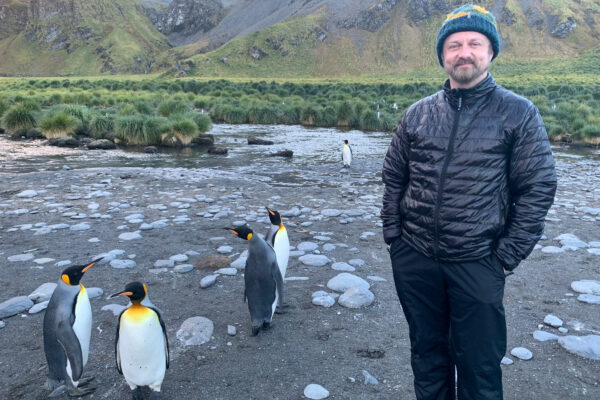
Penguins – many of us would rush to see them on a visit to the zoo. But Jamie Lafferty went much, much further and travelled the planet in a bid to see every species in its natural habitat. He’ll be coming to Wigtown Book Festival to tell us all about it, and will doubtless throw in some impossibly cute pictures as well.
We all love penguins, but few of us travel to some of the most remote parts of the world to look at them. Why did you?
Antarctica is my favourite place anywhere, so that was a big part of the motivation. Although penguins are spread far beyond that continent, it gave me plenty of reasons to go back. I don’t think they’re aware of it, but penguins generally have a great eye for beautiful habitats, too – the South Island in New Zealand, the Galapagos, South Georgia… They’re some of the most sensational environments on Earth. Beyond selfishly wanting to get myself to those places, I was – and still am – interested in what penguins do to people, the crazy infantilising effect they have on most of their observers, including me.
Which did you find the most unusual?
The Tawaki was quite wacky, in that it’s the world’s only forest-dwelling penguin. We’re all conditioned to picture the birds standing around on ice, so to see one instead stumbling over tree roots and swimming in freshwater rivers was very unusual. The Humboldt penguins were also odd for similar reasons – they’re at home in desert conditions, in temperatures that would kill a lot of their cousins. They were even weirder because they make their nests in depressions of guano left behind but hyper-defecating cormorants. I don’t want to kink-shame, but that was pretty weird.
How are penguins faring in a world of climate change?
Really well! Thriving! Joking. LOL. HA-HA. They’re mostly suffering, of course. Disruption of ocean currents, acidification of the water, and most obviously the obliteration of sea ice are all very harmful to marine animals, penguins included. A notable exception is the Gentoo, which is thought to be a climate change winner – its range is slightly expanding. It’s able to thrive, comparatively, because of its high adaptability. Seems old Charlie Darwin might have been right after all.
Is there a particular penguin, or penguin plight, we should be aware of?
The Yellow-Eyed, Galapagos, and African penguins are all likely to become functionally extinct in the next decade. The one that is most inarguably down to human behaviour is the African penguin, as most of its fish stocks are being emptied out by trawlers. Sadly a lot of this fish isn’t even for human consumption – it gets used as fertiliser and for pet food. If you don’t want to contribute their demise, then don’t eat unsustainable fish, or buy it for your pet to eat.
What is your favourite penguin-related anecdote?
When I went to Philip Island just outside of Melbourne, I knew I was going to a pretty commercial penguin-watching enterprise. The Little penguins which live in huge numbers there all return from sea around the same time each evening, so the local conservation group has set up a huge amphitheatre where around 2,000 people can sit and watch the birds return to their burrows. It’s a pretty odd thing to experience, especially when I spent so much time in deeply wild places trying to reach other penguin species. Anyway, the night I was there, a single bird peeled off from the others, ran across the sand, and sought shelter between my legs. Everyone was pretty confused, me and the penguin included.
Any other unusual projects in the pipeline?
Many, but until a new book deal is signed, I can’t really discuss it. In the meantime, I’m working on polar ships, mostly teaching photography. Between me writing this and the book festival, I’ll have been on a trip up to Greenland where the idea is to put the ship in the path of totality during the solar eclipse in mid-August. It’s one of the cloudiest regions on Earth, but we’ll try our best to find a patch of clear sky. There aren’t any wild penguins in the northern hemisphere, but I’ll be ready with a reading from the book if the whole thing is a bust.
You can see Jamie Lafferty at his book festival event on 28th September.
